Author: Marina Giraudeau (Université de Lausanne)
A full report on the conference can be found on the Oxford Medieval Studies website: https://medieval.ox.ac.uk/gboffl-2026/
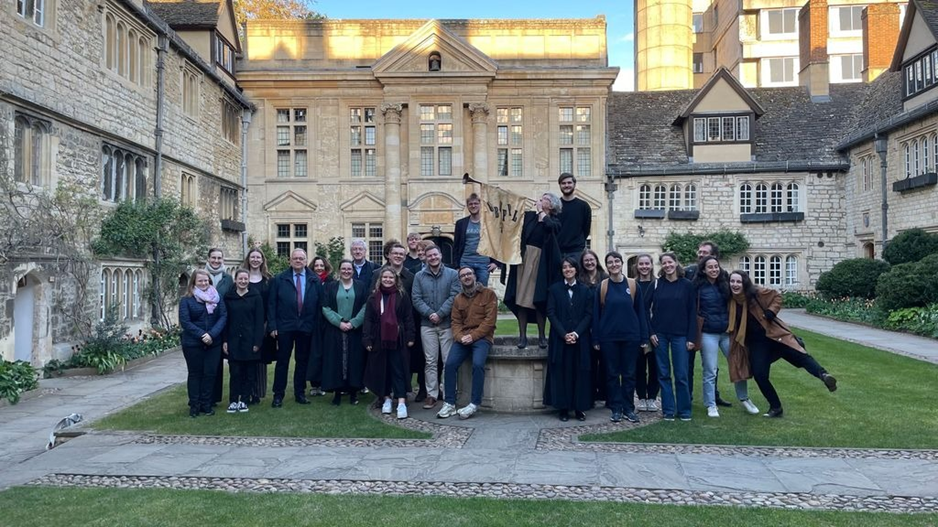
Having studied at the University of Oxford during Michaelmas Term 2025, I was eager for an opportunity to return and further strengthen my academic network overseas. During my internship in 2025, I had the opportunity to deepen my research on the Lausanne prayer book through exchanges with specialists in religious literature, such as Prof. Henrike Lähnemann. I therefore hoped to discuss my edition project further with an audience of scholars in German language and literature. The GBOFFL, an annual conference for young researchers organised by a group of European universities, took place at St Edmund Hall, Oxford, and offered me the opportunity to gain valuable new perspectives on the manuscript I am currently editing: the Lausanne prayer book.
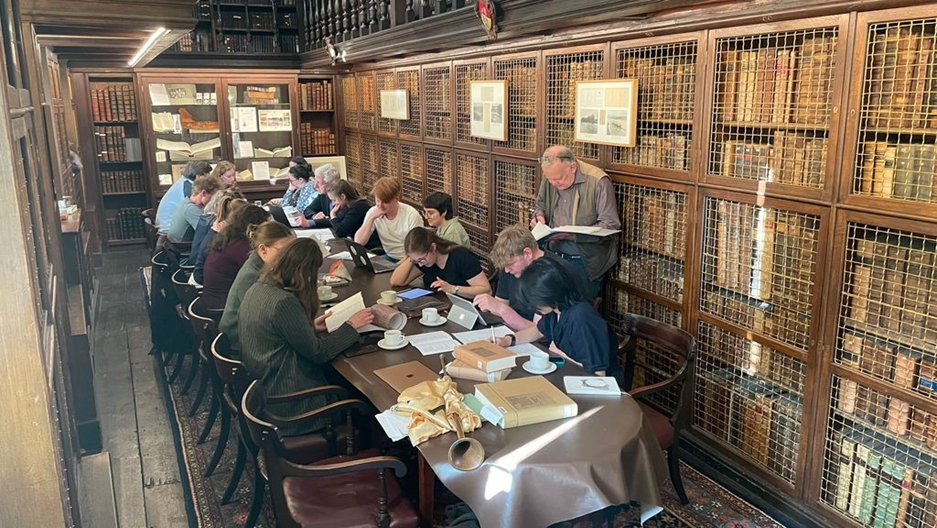
After an initial meeting with the various lecturers in the Old Library, the conference began with a group reading of The Frankfurt Mary Magdalen Play. The edition of this text, largely prepared by Peter Macardle, is now close to publication thanks to the work of Henrike Lähnemann, Carlos Rodríguez Otero, Monty Powell, and Sharang Sharma. Together with three colleagues, I discussed a passage from the Alsfelder Passionsspiel in order to explore how the text may have been performed, before taking on the role of the Devil in front of the other participants. My reading of the Middle High German text helped to make the opposition between the two protagonists in my scene especially clear: the Devil confronts Mary Magdalene and serves as an antithetical symbol to Christianity.
The following day, I was invited to chair the workshop entitled “Jiddische Frühdrucke. Mit einer praktischen Demonstration in der Druckwerkstätte in der Bodleian.” I opened the session by introducing the speaker, Giovanna Truong, a DPhil student at the University of Oxford. The workshop began with a brief introduction to sixteenth-century printing systems across Europe, with a particular focus on Yiddish printing. Truong’s approach attracted considerable interest, and I moderated the subsequent Q&A session. While keeping track of time, I then moved on to the second part of the workshop, in which participants were invited to print their names in sixteenth-century style.
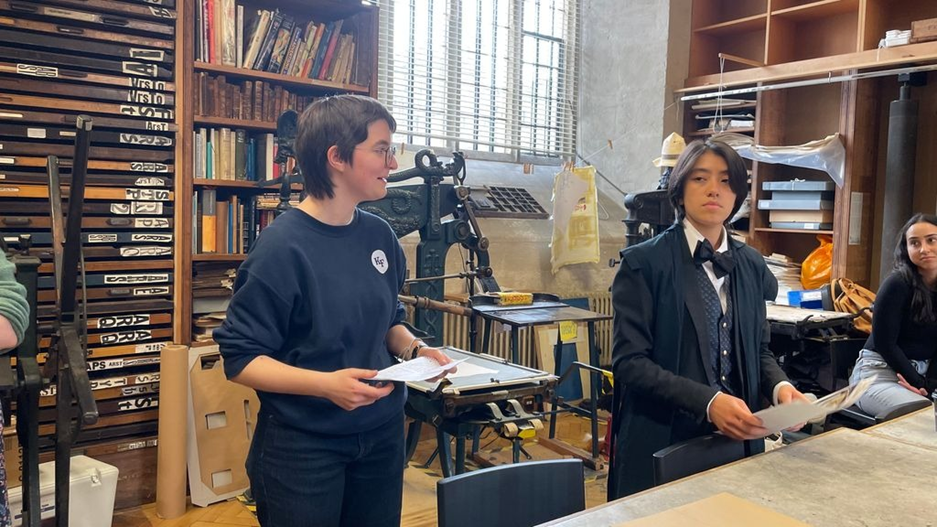
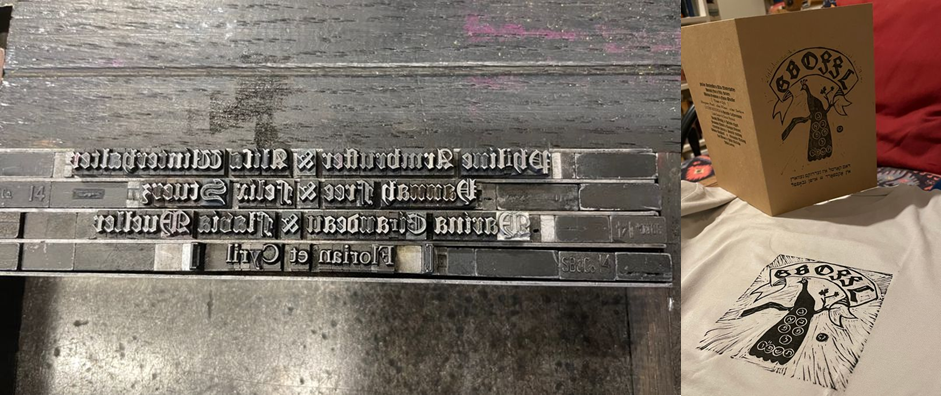
As a fellow Germanist, I was frequently asked to provide further details about the printing process and to clarify the instructions so that each participant could print their name as professionally as possible. With my assistance, participants learned how to use Blackletter type and how to centre their names in order to produce an aesthetically pleasing line. Under the supervision of Prof. Henrike Lähnemann and Richard Lawrence, the participants and I created an original postcard. Thanks to this engaging workshop, we all had the pleasure of taking home our own souvenir of the conference.
Overall, GBOFFL 2026 was a remarkable experience. The presentations enriched my understanding of medieval literature, while the breaks gave me the opportunity to pursue further discussions and to draw comparisons with the Lausanne prayer book. Having participated in GBOFFL for three consecutive years, I was delighted to remain in contact with scholars who share my research interests. I am particularly grateful to the Prayticipate Action, whose Young Researcher and Innovator Conference Grant made my journey to Oxford—and, in a sense, to the Middle Ages—possible.