
Author: Marina Giraudeau (Université de Lausanne)
Since 2023, I have been working on one of only two German manuscripts preserved at the Bibliothèque cantonale et universitaire de Lausanne (BCUL). Although this remarkable document had already been noted in the 1980s by Walter Lenschen, a specialist in medieval German, it has never before been studied in depth. At first glance, it might seem to be simply one more prayer book from the Cologne region, an area well known for its rich liturgical culture. Yet a closer look reveals a manuscript with a number of striking and unusual features. In this blog post, I would like to introduce the Lausanne Prayer Book through three of its most intriguing particularities.
Ripuarian, a dialect from the borders
The prayers, which fill nearly 250 folios of the codex, are written in the vernacular. The language of the manuscript, identified as Ripuarian, is crucial for locating its origins. This dialect was spoken in and around Cologne, in what is now western Germany. In the late Middle Ages, Cologne stood within a multilingual zone, and this linguistic environment shaped a dialect situated at the crossroads of Low German and Middle High German. As a result, some words in the manuscript sound surprisingly close to modern Dutch, while others are more familiar from standard German.
| Word in the ms. (f. 13r) | Modern Dutch | Modern German |
| drijveldicheit | drievuldigheid | Dreifaltigkeit |
| hemel | hemel | Himmel |
| erden | aarde | Erde |
| machen | maken | machen |
Even these few examples give a sense of the manuscript’s linguistic richness and of the cultural world in which it was produced.
Three hands—and an enigmatic binding
The manuscript is also fascinating from a codicological point of view. Its text is the work of three different scribal hands. The main and third hands were responsible for almost the entire codex, from the liturgical calendar to the final prayer (ff. 6r–238v). The first two hands, by contrast, appear together only on five folios and copied a prayer on the Fifteen Joys of Christ on the Cross.
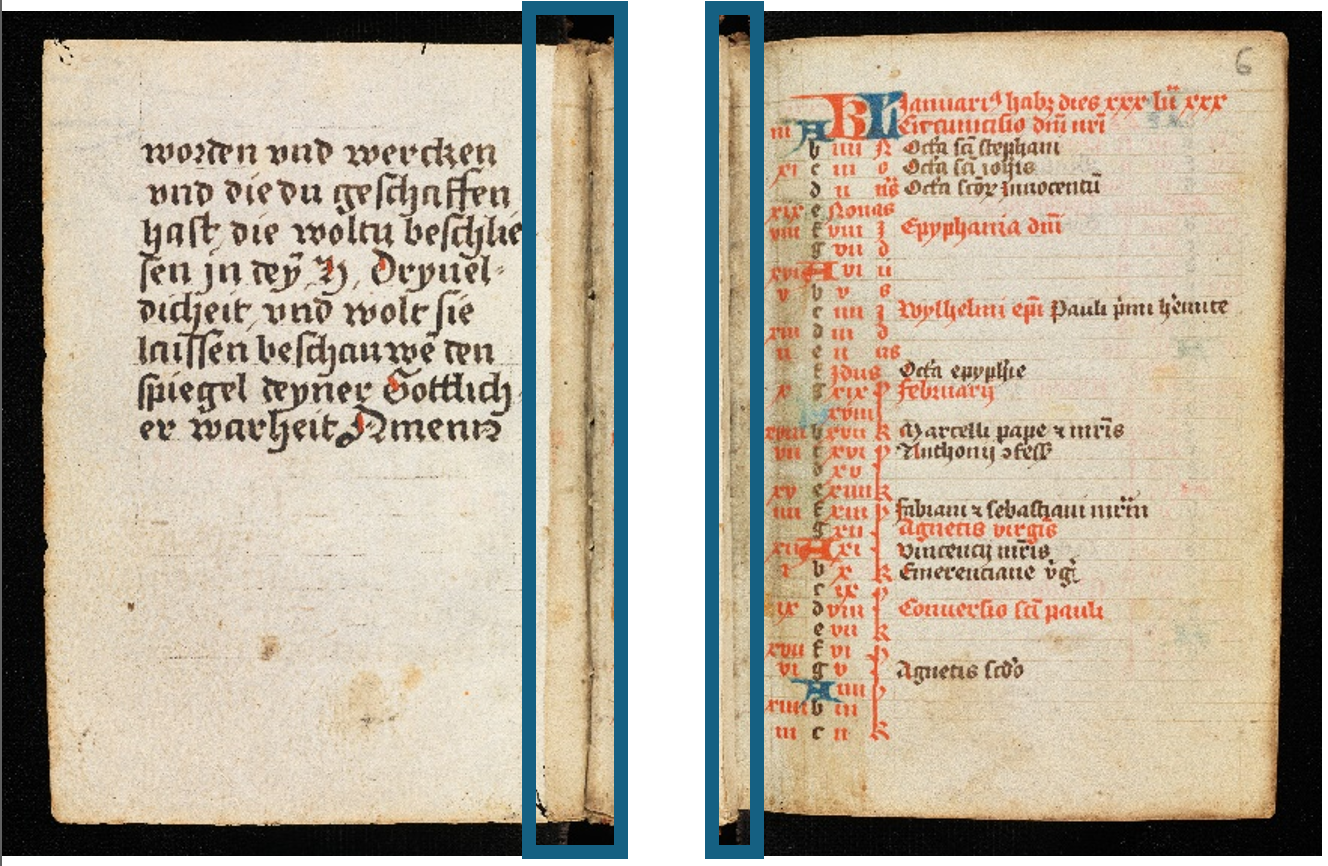
How this text came to be bound together with the rest of the collection remains something of a mystery. It seems that a folded sheet of paper (ff. 4–5) was attached to a parchment strip belonging to the original folio 5, but the binding of the first three parchment folios cannot be explained on the basis of a quick visual examination alone. This raises a series of questions that continue to intrigue me: was this opening prayer added to an already existing liturgical program? And if so, do these two hands postdate the main copyist?
Unusual visual program
The visual program of the manuscript is equally distinctive. It includes 18 miniatures, which partly serve to structure and introduce different sections of the prayer book. One example is the miniature of the Adoration of the Magi (f. 44v), which marks the beginning of the prayers dedicated to the Three Kings (ff. 45r–48v).
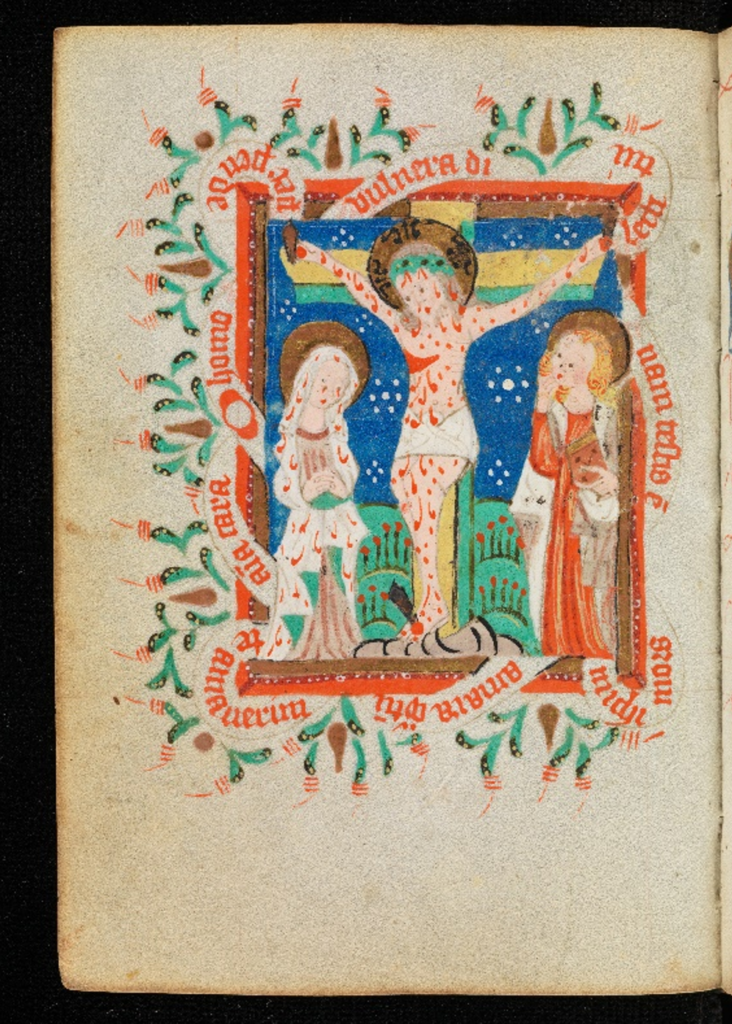
Yet these images do more than organise the text. They also participate in a broader visual tradition, one that often places strong emphasis on the Passion of Christ. This makes the Lausanne Prayer Book all the more surprising: despite that tradition, it contains only a single representation of the Crucifixion and no further depictions of Christ’s suffering. This apparent departure from expectation invites further investigation. A closer study will be needed to determine to what extent the manuscript differs from other prayer books produced in this region during the sixteenth century.
These three aspects offer just a first glimpse into the many questions the Lausanne Prayer Book raises. In future work, I hope to explore them more fully and to place this manuscript within wider discussions of devotional culture, materiality, and intermediality. To do so, I would very much like to collaborate with specialists from other fields, including fellow members of the PRAYTICIPATE Action, whose expertise may help illuminate some of the questions outlined