
Drought is one of the oldest crises in human history. When fields cracked, animals went without water, and communities faced starvation, there were no weather forecasts, no reservoirs. And drought rarely came alone — it brought famine, epidemic disease, and waves of displacement in its wake. Under the combined pressure of nature and these crises, communities came together and prayed. This collective act — the rain prayer — is not merely a religious ritual. It is also a form of social solidarity. And this is precisely what our project sets out to investigate.
A Project Rooted in the Early Islamic World
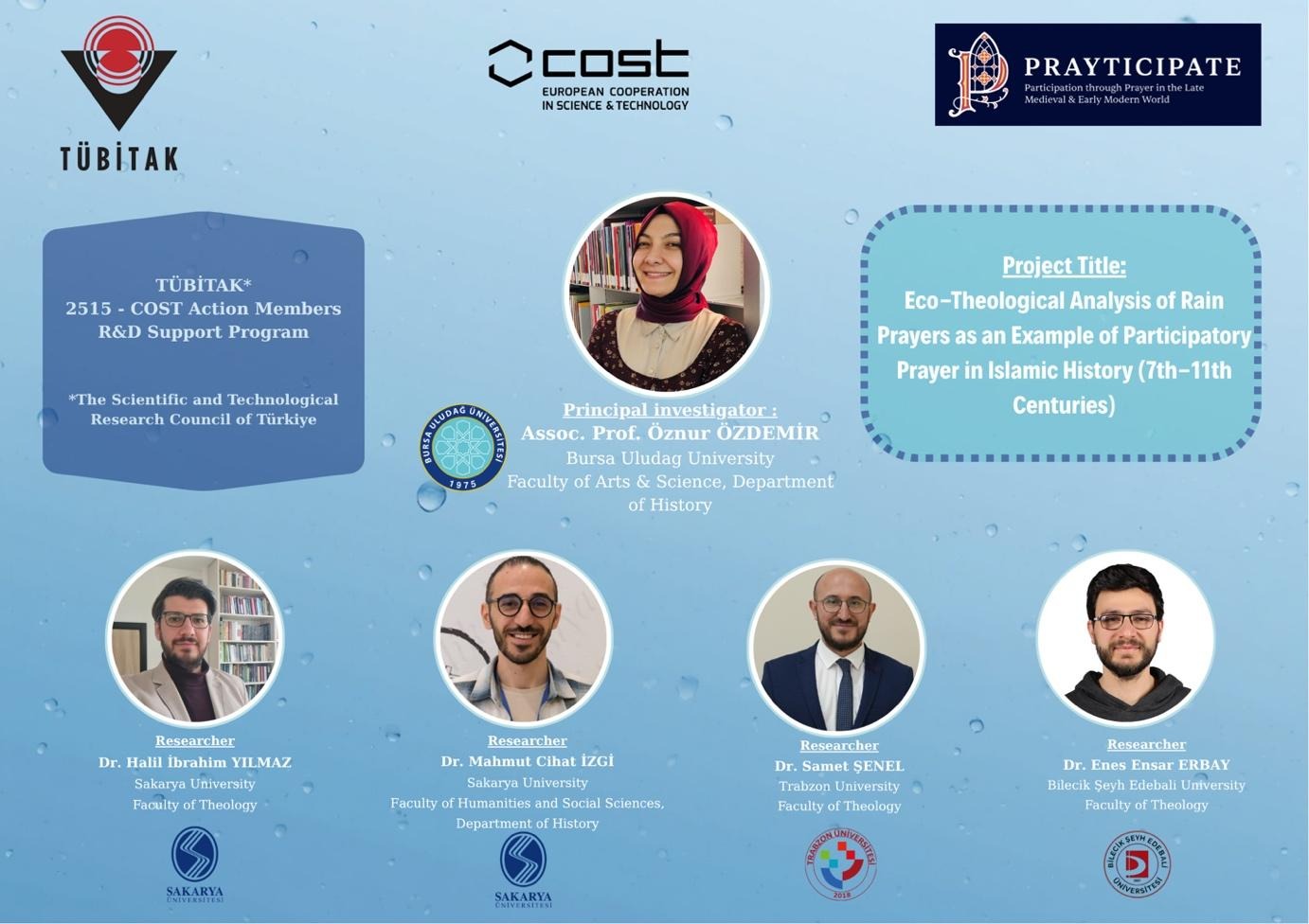
Our project, titled “Eco-Theological Analysis of Rain Prayers as an Example of Participatory Prayer in Islamic History (7th–11th Centuries)”, is funded by the Scientific and Technological Research Council of Türkiye (TÜBİTAK) 2515-COST Programme and focuses on the first centuries of Islamic history.
The project is led by Assoc. Prof. Öznur Özdemir (Department of History, Bursa Uludağ University). The research team consists of Dr. Halil İbrahim Yılmaz (Faculty of Theology, Sakarya University), Dr. Mahmut Cihat İzgi (Middle East Institute, Sakarya University), Dr. Samet Şenel (Faculty of Theology, Trabzon University), and Dr. Enes Ensar Erbay (Faculty of Theology, Bilecik Şeyh Edebali University). Together, the team investigates the historical, social, environmental, and theological dimensions of rain prayers as participatory religious practices in medieval Islamic societies.
Why this period? Early Islamic sources suggest that it is precisely during these centuries that the rain prayer became institutionalised — taking shape from the Prophet’s own practice and gradually developing into a communal custom. Within this framework, we examine how the rain prayer — known in Arabic as Ṣalāt al-istisqāʾ (صلاة الإستسقاء)— was performed, what social meanings it carried, and how it reflected the relationship between human beings and the natural world.
Our sources are classical Islamic texts: hadith collections, biographical dictionaries, historical chronicles, and prayer books. We compile these materials from digital Arabic libraries such as al-Maktaba al-Shāmila and KURAMER, then code and subject them to thematic analysis using MAXQDA qualitative data analysis software. This approach allows us to combine the depth of traditional historical research with the possibilities offered by the digital humanities.
Eco-Theology as a Lens
At the heart of our project is the concept of eco-theology — an approach that examines the relationship between religion and nature and shows how religious texts and rituals also reflect the ways in which people understood and related to their environment. In the context of the rain prayer, we are guided by a set of interlocking questions: To what extent do these rituals reflect how society organised itself in a moment of crisis? Was drought interpreted as divine punishment, or as a test? What role did religious authority — the imam, the caliph, the qadi — play in the face of natural disaster? And how did different social groups come together through these rituals?
These questions remain very much alive today. More than two billion people do not have access to enough clean water. From the wildfires of California to the droughts of East Africa, from the dry rivers of South Asia to the water shortages of the Middle East, communities around the world still face the same basic problem that drove people to pray for rain a thousand years ago. Looking back at how people dealt with these crises in the past may help us think differently about the challenges we face today.
Part of PRAYTICIPATE
Our project forms part of COST Action CA23143 – Participation through Prayer in the Late Medieval and Early Modern World (PRAYTICIPATE) by aiming to strengthen the network’s cross-cultural dimension by providing systematic data from the early Islamic world, making possible a comparative picture that spans both Christian and Islamic traditions. We plan to regularly share our findings with network members through webinars and presentations. Over the course of this 24-month project, we aim to publish our results in peer-reviewed journals and to contribute to the growing field of comparative religious and environmental history.
A Ritual That Holds More Than It Appears
At first glance, a rain prayer may seem like a simple plea directed at the clouds. But within it lies social organisation, environmental perception, crisis management, and collective consciousness. History gives us not only the answer to what happened? but also to how did the human being come together? And perhaps, to better understand need for collective actions for today’s water crises, we need to look back at the rain prayers of a thousand years ago; their motivations and beliefs.
In future work, we hope to explore these themes more fully and to situate this research within broader discussions of collective ritual, religious authority, and environmental history. To do so, we would very much welcome collaboration with specialists from related fields, including fellow members of the PRAYTICIPATE network, whose expertise may help illuminate some of the questions outlined here.
Have you ever witnessed a collective ritual in response to a natural crisis in your own community? We would love to hear your thoughts.
Research team of the TÜBİTAK-COST funded project on rain prayers in early Islamic history, affiliated with PRAYTICIPATE.