Report on the WG1 “Material Realities of Prayer” Workshop in Hamburg
10–12 June 2026, Hamburg
COST Action CA23143 PRAYTICIPATE – Participation through Prayer in the Late Medieval and Early Modern World
Written by Carolin Gluchowski
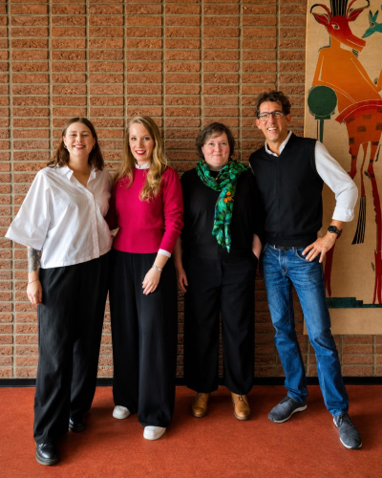
From 10 to 12 June 2026, Working Group 1 “Material Realities of Prayer” of the COST Action CA23143 PRAYTICIPATE met in Hamburg for the in-person workshop “Reconsidering the Vocabulary of Prayer Through Objects.” The workshop was organised by Sara Carreño (University of Santiago de Compostela), Carolin Gluchowski (University of Hamburg), Stefan Matter (University of Bern / University Library Bern), and Katrin Janz-Wenig (State and University Library Hamburg). The aim of the workshop was deliberately concrete. Rather than approaching prayer only as a theological, textual, or abstract category, participants explored how scholarly vocabulary changes when tested against specific objects, materials, collections, spaces, and practices. The workshop asked what happens when familiar terms such as private, personal, communal, institutional, devotional, liturgical, para-liturgical, meditative, contemplative, prayer book, or image are confronted with manuscripts, printed books, textiles, portable altars, amulets, visual media, museum objects, and archival or catalogue descriptions.
The Hamburg meeting formed part of a three-stage workshop structure. A preparatory online session on 29 May 2026 introduced participants to the aims and methodology of the workshop. It included a keynote lecture by Ingrid Falque, Sarah Borges, Solène Lecuivre, and Mathilde Marès (UCLouvain) on the collaborative process of the research group Essais de terminologie(s): images, textes, spiritualité at the Centre for Early Modern Cultural Analysis (GEMCA, UCLouvain). Their lecture offered an important conceptual basis for the in-person discussions by showing how terms connected to image, text, spirituality, devotion, and prayer are shaped by disciplinary traditions, languages, historical sources, and methodological choices.
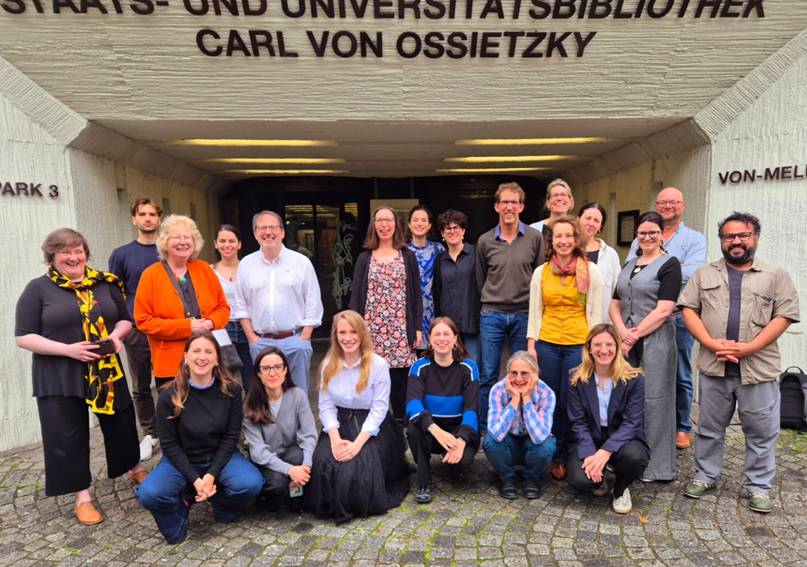
The in-person workshop began on 10 June at the State and University Library Hamburg Carl von Ossietzky with the session “Manuscripts and Prints,” chaired by Carolin Gluchowski. The session focused on the instability of familiar book-historical and codicological categories and on the ways in which manuscripts and printed books resist being reduced to stable labels such as “book of hours,” “prayer book,” or “devotional miscellany.”
Anna Dlabačová (Leiden University) opened the session with a paper on books of hours in the Middle Dutch translation ascribed to Geert Grote. Moving beyond the broad label “Book of Hours,” she proposed a tentative classification of Middle Dutch printed books of hours produced between c. 1480 and 1550: basic or universal books of hours, full or complete books of hours, the Dutse getijden or Dutch Hours, and more alternative books of hours, in which Grote’s hours were reorganised within different devotional structures. Particularly important for the workshop was her emphasis on modularity: some printed books allowed readers or buyers to select, combine, and reorder texts, producing materially and functionally hybrid objects. Her paper, therefore, showed that classification can serve not as a rigid system, but as a heuristic tool for making visible the diversity of texts, formats, and practices hidden beneath a single inherited label.
Wendy Scase (University of Birmingham) turned attention to prayer material often hidden under codicological labels such as “pen trials,” “inscriptions,” or “additions.” Her examples from manuscript flyleaves and margins raised the question of what counts as prayer when the material consists of short formulas, names such as Jesus and Mary, ownership inscriptions, or writing exercises. The paper made especially clear that catalogue terminology can render prayer-related material invisible: if a prayer formula is described only as a “pen trial,” its devotional, pedagogical, or pious function may disappear from view.
Vittorio Frighetto (University of Padua) examined composite devotional manuscripts through the case of Paris, Bibliothèque de l’Arsenal, MS 424, a richly varied manuscript completed in 1493 by Gerthrud Bay, probably a Brigittine nun from Mariënwater in North Brabant. The manuscript combines Latin offices, Middle Dutch prayers, meditations, spiritual exercises, rosaries, devotional acts, and texts for communal and individual use. Frighetto’s paper showed how terms such as ghebet prayer, belijnghe confession, over dencken meditation, and cursus might help us develop a more precise vocabulary from the internal terminology of the sources themselves rather than relying only on modern catalogue labels.
Hanna Gentili (University of Hamburg) brought Jewish manuscript traditions into the discussion through a comparative approach to prayer books and prayer materials. Her contribution emphasised that Jewish manuscript cultures developed in continuous dialogue with surrounding Christian and Muslim book cultures, while also preserving locally specific rites, customs, scripts, layouts, and iconographic choices. Her case study of a Hebrew festival prayer book, or Mahzor, in the Hamburg collections showed how prayer, calendar, custom, rite, community, and codicological structure intersect in ways that invite comparison without forcing Jewish material into inherited Christian categories.
Taken together, the first session demonstrated that manuscripts and printed books should not be understood simply as containers of prayer texts. They are changing assemblages of texts, images, rubrics, annotations, ownership traces, material additions, cataloguing histories, liturgical forms, personal practices, and communal memories. The discussion repeatedly returned to one of the workshop’s central principles: categories are necessary, but they must remain provisional, case-sensitive, and open to revision.
On 11 June, the workshop continued with the session “Artworks and Objects,” chaired by Ingrid Falque. This session shifted the focus from books to textiles, portable altars, and Islamic amuletic objects, placing pressure on distinctions between domestic and ecclesiastical, devotional and liturgical, official and unofficial, prayer and protection, image and object.
Solène Lecuivre (UCLouvain) discussed a small Flemish tapestry of 1608 integrated into a wooden retable and connected with the cult of the Virgin of Scherpenheuvel. The central textile image, the presence of the Archdukes, ex-votos, figures of the sick and healed, and painted donor wings together created an object that could not easily be described as merely domestic, devotional, commemorative, liturgical, or pilgrimage-related. Her paper showed how tapestries could operate as mobile spatial devices that shaped ritual environments, sensory atmospheres, and the conditions under which prayer unfolded.
Anna Seragiotto (University of Padua) examined medieval portable altars and the terminological ambiguities they produce. Through examples such as the portable altar with angels and cherubim in Berlin and the portable altar associated with Countess Gertrude of Brunswick in Cleveland, she showed that these objects were not only liturgical instruments for the celebration of the Eucharist. Their inscriptions, precious materials, iconographic programmes, dynastic associations, and use in relation to relic display reveal them also as objects of memory, mobility, self-representation, and communal performance.
Isa Babur (Iğdır University / Sakarya University) introduced Islamic muska and hamâil objects as a comparative “terminological stress test” for the vocabulary of prayer. His paper treated these objects not simply as amulets or talismans, but as written protective objects in which Qurʾanic verses, divine names, supplications, numerical grids, containers, bodily carriage, and traces of wear come together. This contribution opened an important interreligious perspective by asking how terms such as prayer, protection, magic, inscription, embodiment, and efficacy shift when applied beyond Christian material.
The session made clear that prayer is often materially organised through mobility, inscription, bodily proximity, handling, display, concealment, and use-wear. It also showed that inherited binaries, such as liturgical/devotional or official/unofficial, are often inadequate. Objects may move across these categories over time or occupy several of them simultaneously.
The third session, “Religious Communities,” chaired by Katrin Janz-Wenig, brought the discussion back to communities, institutions, and devotional environments. The papers explored how prayer practices were shaped by rules, gendered spaces, communities of use, traditions of reuse, and the interaction between books, images, bodies, and architectural settings.
Mercedes Pérez Vidal (Autonomous University of Madrid) examined complex written and material artefacts in women’s religious communities, especially in Iberian and comparative European contexts. Her paper challenged terms such as Bilderhandschrift or picture book, Gebetbuch or prayer book, Andachtsbuch or devotional book, and Andachtsbild or devotional image. By considering artefacts that could function with or without written prayers, and in relation to external images, bodily practices, and mental images, she asked whether inherited German and Anglo-Saxon categories can adequately describe the devotional cultures of women religious in other regions.
Starting from an illuminated manuscript of the early fourteenth century, Lenka Panušková (Czech Academy of Sciences) and Katrin Janz-Wenig (Hamburg State and University Library) explored the afterlife of medieval manuscripts in processes of monastic self-reflection during the Early Modern period. Panušková’s research on prayer, female piety, and illuminated manuscripts -including material connected with the Benedictine convent of St George at Prague Castle – raised the question of how images and manuscripts could shape or guide devotional practices over time. Janz-Wenig’s complementary contribution drew attention to the diachronic lifespan of devotional objects: manuscripts belong not only to the moment of their creation, but may also be reinterpreted, reused, and reactivated in later monastic contexts. In the specific case discussed, the manuscript was translated and adapted around 1720.
Rogier Gerrits (University of Hamburg) addressed prayer as an intermedial practice in seventeenth-century French meditation guides, especially through Maurice Le Gall’s Oratoire du coeur and related devotional media. His paper asked how external media and combinations of media could support an internal practice of the heart. Terms such as intermediality, recollection, verticality, interiority, and communication with the divine became important tools for thinking about how prayer could be structured through spatial, visual, textual, and affective means.
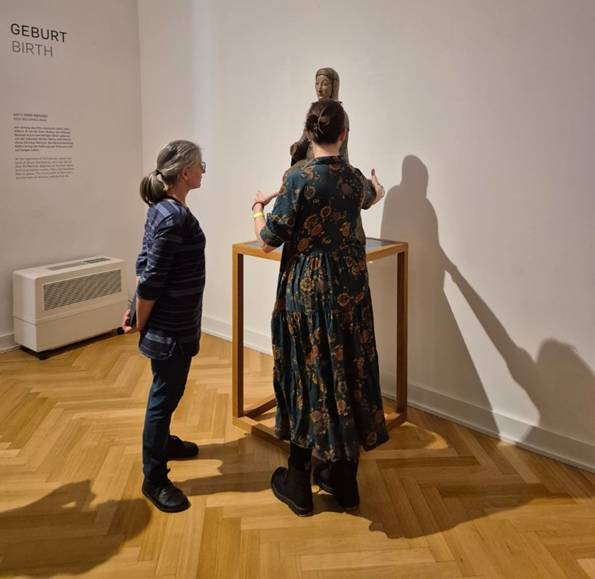
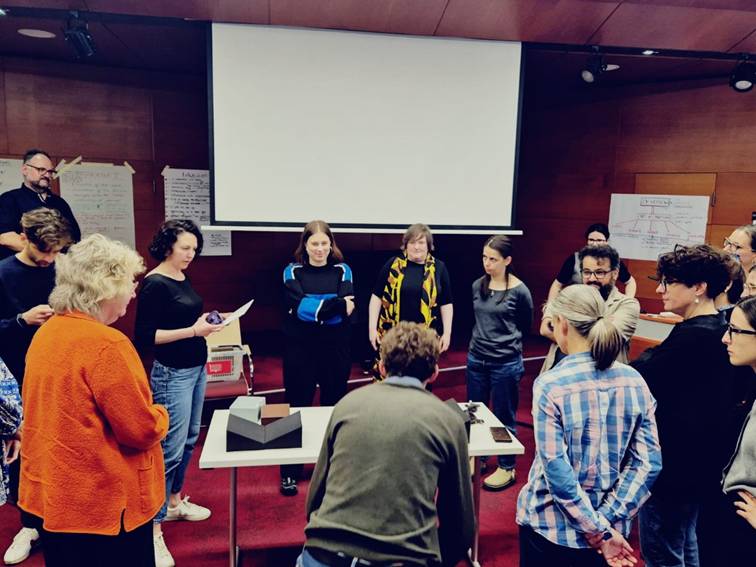
A publisher session with Isabelle Väth from Brill / De Gruyter offered participants the opportunity to discuss possible publication formats and future outputs. The day concluded with a visit to the Museum für Kunst und Gewerbe Hamburg, where participants continued the conversation in direct engagement with objects and collections. This object-based encounter made one of the workshop’s central insights especially tangible: vocabulary is not refined only through theoretical discussion, but also through the slow and careful encounter with things.
The final day opened with the session “Sensory Experience,” chaired by Sara Carreño. The session asked how prayer might be described when attention shifts from text and object type to sound, rhythm, touch, visual absorption, time, affect, and bodily experience.
Cynthia Turner Camp (University of Georgia) examined voiced prayer in English books of hours and prayer books. Her contribution focused on how written signs became spoken or heard prayerful sounds, and how page layout, verse form, sequencing, and manuscript context could cue vocalisation. By considering concepts such as entrainment, temporality, and aural experience, her paper argued that prayer should be studied not only as written text or internal meditation, but also as a time-bound, embodied, and potentially audible practice.
Vassilis Vavoulis (Athens Conservatory) asked what is lost when books of hours are described simply as “prayer books.” His paper emphasised their multisensory and affective life: books of hours could enable prayer, but also offer visual pleasure, tactile comfort, emotional regulation, social prestige, family memory, and forms of escapism. He proposed a richer vocabulary attentive to haptic devotion, ocular absorption, sensory engagement, emotional work, and the body’s role in the experience of prayer-related objects.
Mathilde Marès (UCLouvain) returned to the term devotio through a lexicographical and philosophical examination of the Thomistic corpus. By focusing on devotio as a virtue that mediates between interior and exterior acts of religion, she showed how medieval theological vocabulary can clarify the relationship between prayer, devotion, inward disposition, and outward practice. Her paper reminded the group that modern terms such as “devotion” carry long theological histories that need to be understood before they are applied to images, objects, or practices.
The discussion highlighted the need for terminology that can better register sound, rhythm, touch, affect, mental attention, and bodily comportment. Prayer appeared here not simply as a text to be read or a formula to be recited, but as a situated sensory and embodied activity that unfolds in time.
The final paper session, “Vernacular Prayer,” chaired by Stefan Matter, continued these questions through the study of translated liturgical and basic prayers.
Youri Desplenter (Ghent University) discussed liturgy in the vernacular and devotional practice through MS Utrecht, University Library, 1039, a richly decorated fifteenth-century manuscript containing Middle Dutch versions of liturgical hours, a translated liturgical psalter, and the Litany of All Saints. The manuscript, owned by two tertiaries from the Utrecht Mariaconvent, complicates terms such as prayer book, psalter, book of hours, lay breviary, private, communal, liturgical, and paraliturgical. His paper asked whether vernacular translations of liturgical sung texts functioned as aids, subtitles, rubrical tools, independent prayers, or several of these at once.
Dorota Masłej (Adam Mickiewicz University) approached vernacular basic prayers as objects of linguistic, devotional, and didactic research. Her work on Old Polish translations of the Lord’s Prayer and the Creed showed how basic Christian texts became central witnesses to processes of Christianisation and vernacularisation. By analysing the layout of Latin and Polish prayers, divisions, diagrams, and explanatory material on the manuscript page, she demonstrated that prayer could function simultaneously as text, teaching tool, memory aid, and object of translation.
The workshop concluded with a session led by Katrin Janz-Wenig, Carolin Gluchowski, and Hanna Gentili on manuscripts in the Hamburg collections, followed by closing remarks and a visit to the Hamburger Kunsthalle. These final object-based encounters returned the group to the material and institutional setting of the workshop. Libraries and museums do not simply preserve prayer-related objects; they also shape the vocabularies through which those objects become searchable, describable, comparable, and interpretable.
Across the three days, several shared questions emerged. How can we describe prayer without reducing it to text? How can we speak about objects that mediate prayer without assuming that their function was stable, singular, or exclusively devotional? How should catalogues and databases register traces of use, bodily interaction, sound, movement, affect, reuse, or uncertainty? What terms are needed for objects that move between private and communal use, between domestic and institutional spaces, between liturgy and devotion, between image and text, between prayer and protection? And how can we remain attentive to the vocabularies of historical sources without simply reproducing modern disciplinary categories?
The discussions also showed the importance of distinguishing between object type, use, function, setting, practice, perception, and later scholarly interpretation. A book may not always function primarily as a “prayer book”; a portable altar may not be only a liturgical instrument; a tapestry may not be merely an image; a muska may not be adequately described by the terms “amulet” or “talisman”; a catalogue entry may obscure the prayer-related significance of a marginal note or inscription. In many cases, the most productive result was not a new fixed label, but a more precise account of the conditions under which a term works — and the point at which it begins to fail.
One recurring theme was the need to think diachronically as well as synchronically. Objects often changed meaning as they moved across spaces, owners, communities, institutions, and periods of use. A manuscript might be personalised, rebound, annotated, inherited, catalogued, or reinterpreted; an object might shift from domestic devotion to liturgical use, from private possession to communal memory, or from active practice to museum display. These movements are not secondary to the study of prayer. They are part of the material history through which prayer practices become visible.
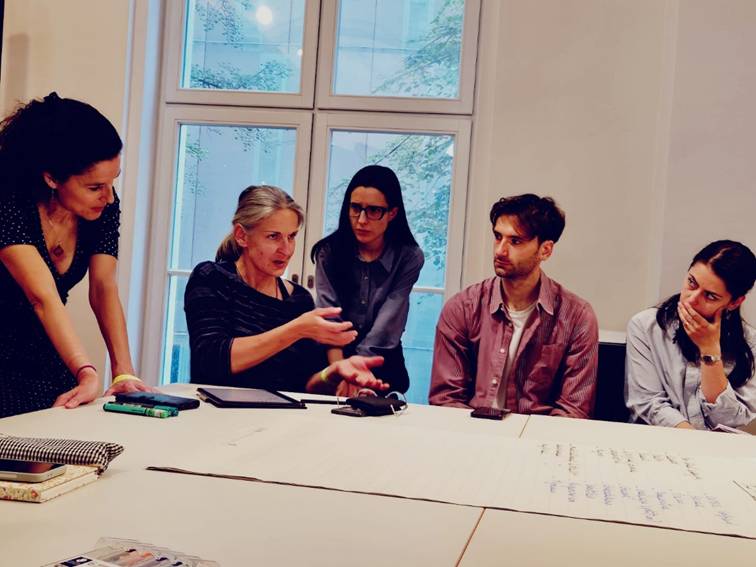
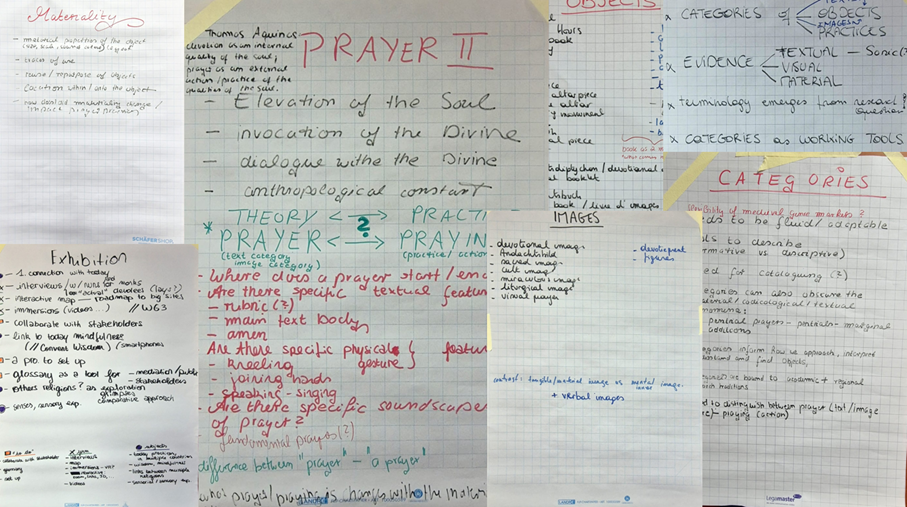
The workshop did not aim to produce a closed glossary or a definitive terminology. Instead, it functioned as a collaborative laboratory for testing words against objects. Its results will feed into the further work of WG1, including the development of case vignettes, methodological reflections, and a shared terminology glossary or toolkit grounded in object-based analysis. A follow-up online meeting in autumn 2026 will allow participants to refine these materials and continue the collective discussion.
We are grateful to the COST Association for supporting this workshop and to all partner institutions, speakers, chairs, and participants for their generous contributions. The Hamburg meeting demonstrated how fruitful it can be to reconsider prayer through objects: not as illustrations of already established concepts, but as active participants in the making, shaping, and challenging of scholarly vocabulary.
By bringing together manuscripts, prints, textiles, altars, amulets, images, collections, and spaces, the workshop opened new perspectives on prayer as a material, sensory, embodied, communal, intermedial, and participatory practice. It marked an important step in the work of PRAYTICIPATE and in the development of a more precise, flexible, and historically sensitive vocabulary for the study of late medieval and early modern prayer.