
Report on six paper sessions and the round table “The Future of Prayer Studies”
6 and 9 July 2026, Leeds | Written by Carolin Gluchowski
On 6 and 9 July 2026, COST Action CA23143 PRAYTICIPATE hosted six paper sessions and a round table at the International Medieval Congress (IMC) in Leeds. Responding to the congress’s special thematic strand, “Temporalities,” the programme brought together scholars working on manuscripts, literature, images, liturgy, theology, music, digital methods, and religious experience. The sessions were organised by Youri Desplenter (Ghent University), Anna Dlabačová (Leiden University), Carolin Gluchowski (University of Hamburg), and Thor-Oona Pignarre-Altermatt (UCLouvain).
The programme began from a deceptively simple premise: prayer does not merely occur in time. It also produces temporal structures and experiences. Prayer can divide the day into hours, return communities to the same feasts and narratives, make past events present, anticipate the end of time, or seek to move beyond ordinary chronology altogether. These temporalities are never shaped by words alone. Books, calendars, rubrics, poetic forms, images, sculptures, sounds, gestures, bodies, and institutional routines all help to determine how prayer is performed and experienced.
Across the two conference strands—“Private Prayer Across Time and Media in the Late Middle Ages” on Monday and “Religious Temporalities and Liturgical Prayer Books” on Thursday—the papers repeatedly challenged any straightforward opposition between private and communal, textual and material, liturgical and devotional, or historical and timeless prayer. The round table “The Future of Prayer Studies” placed these case studies within a wider discussion of the field’s blind spots, methods, and possibilities.
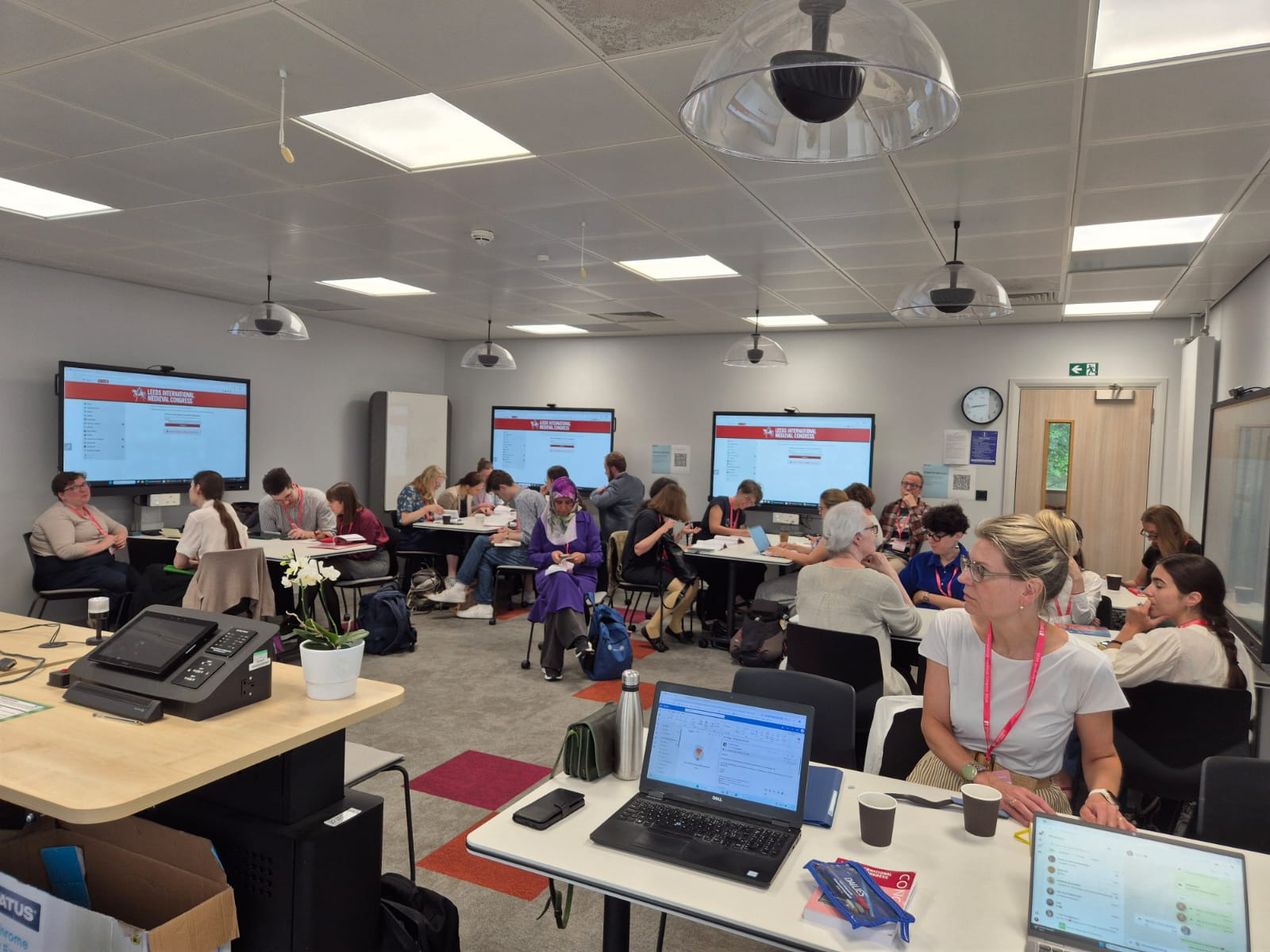
Monday, 6 July: Private Prayer Across Time and Media
The first strand, organised by Anna Dlabačová and Thor-Oona Pignarre-Altermatt, examined how books, poetry, and images could structure devotional time beyond the formal performance of the liturgy. The papers moved from medieval prayer books to a contemporary digital reimagining of the Book of Hours, from Chaucer and Italian spiritual poetry to Last Judgement imagery and articulated sculptures. Together, they showed that “private” prayer was never simply an inward or isolated activity. It was mediated by inherited forms, material objects, social practices, and imagined communities.
Temporality in Prayer Books
The opening session, chaired by Thor-Oona Pignarre-Altermatt, began with Lieke Andrea Smits (Leiden University), who discussed Lucy English’s The Book of Hours, a digital project completed in 2018. Its forty-eight poetry films—one for the morning, afternoon, evening, and night of each month—translate the calendar and daily rhythm of a medieval Book of Hours into a secular, contemporary practice of contemplation. Smits approached this project through cultural transfer: English did not reproduce a particular medieval manuscript, but selected and transformed characteristic features of the Book of Hours, including its temporal structure, visuality, portability, and capacity to interrupt everyday activity.
The comparison also revealed a significant shift. Medieval books of hours cultivated a relationship between the temporal worshipper and an eternal God; the contemporary project redirects contemplation towards the self, the natural world, and the pace of modern life. At the same time, both medieval and digital books proved materially and semantically unstable. Medieval manuscripts were expanded, rearranged, dismantled, and reused, while English’s films circulate independently across websites, festivals, video platforms, and print. The Book of Hours thus appeared not as a fixed form inherited unchanged from the past, but as a mobile temporal structure capable of acquiring new meanings in changing media.
Marina Giraudeau (University of Lausanne) turned to the German prayer book Lausanne, Bibliothèque cantonale et universitaire, TP 2858. Through its calendar, arrangement of prayers, recurring verbal structures, and use of grammatical tense, she identified several forms of time operating simultaneously. The fixed feasts of the saints created a cyclical year; prayers following the life and Passion of Christ retained a historical and narrative sequence; repeated initials, formulas, and syntactical patterns supported ritual recurrence; and the frequent use of the present tense made sacred events available to renewed devotional participation. Her close analysis showed that the prayer book did not merely describe liturgical time. Its material and linguistic structures trained the reader to inhabit it.
The two papers nevertheless established questions that would recur throughout the programme: how do books organise attention, how do repetition and media make sacred history present, and what happens when devotional forms travel into new contexts?
Poetics of Prayer
The second session, chaired by Carolin Gluchowski, shifted attention from the organisation of prayer books to the temporal work performed by poetic form.
Dominika Ruszkiewicz (Ignatianum University in Kraków) examined the temporalities of Chaucer’s An ABC to the Virgin. Drawing on the concept of the chronotope, she identified a productive tension between two structures. The litanic mode is concentric and potentially endless: Mary occupies the still centre from which divine power and intercession radiate. The alphabetic form, by contrast, moves linearly from A to Z and gives the prayer a finite duration. Chaucer’s penitent speaker is caught between these temporal orders. He seeks access to Mary’s eternity while fleeing sin within the urgent present of prayer. The poem’s devotional force arises precisely from the intersection of circular contemplation and linear progression.
Marlene Dirschauer (University of Hamburg) explored repetition and remembrance in John Lydgate’s Testament and George Herbert’s The Sacrifice. Her comparative reading treated adaptation itself as a form of repetition across the Reformation divide. In Lydgate’s late medieval poem, Christ repeatedly commands the reader to “behold,” drawing on a devotional culture in which images and words worked together to make the Passion present. Herbert retains the repetitive structure but shifts its force into language, above all through the recurring refrain “Was ever grief like mine?” Verbal rhythm assumes mnemonic and affective work once performed by the devotional image. Yet Herbert’s repetition also arrests time: the Passion is continually reactivated in an inescapable “now,” rather than unfolding towards the more clearly progressive future envisioned by Lydgate.
Marc Föcking (University of Hamburg) then moved from English to Italian spiritual poetry in a paper structured around “fighting,” “filling,” and “killing” time. Drawing on authors from Jacopone da Todi to Vittoria Colonna and Gabriele Fiamma, he asked how prayer and devotional poetry respond to the scarcity and perceived danger of earthly time. Spiritual verse warns against time wasted in worldly pursuits, fills daily life with repeated devotional activity, and seeks to anticipate the timelessness of heaven. The Rosary became especially important in this development: its circular and repetitive structure offered an alternative to the linear narratives of secular love poetry. In Rosary books that coordinated prayers with sonnets and other poetic forms, reading and recitation together produced a foretaste of eternity within ordinary life.
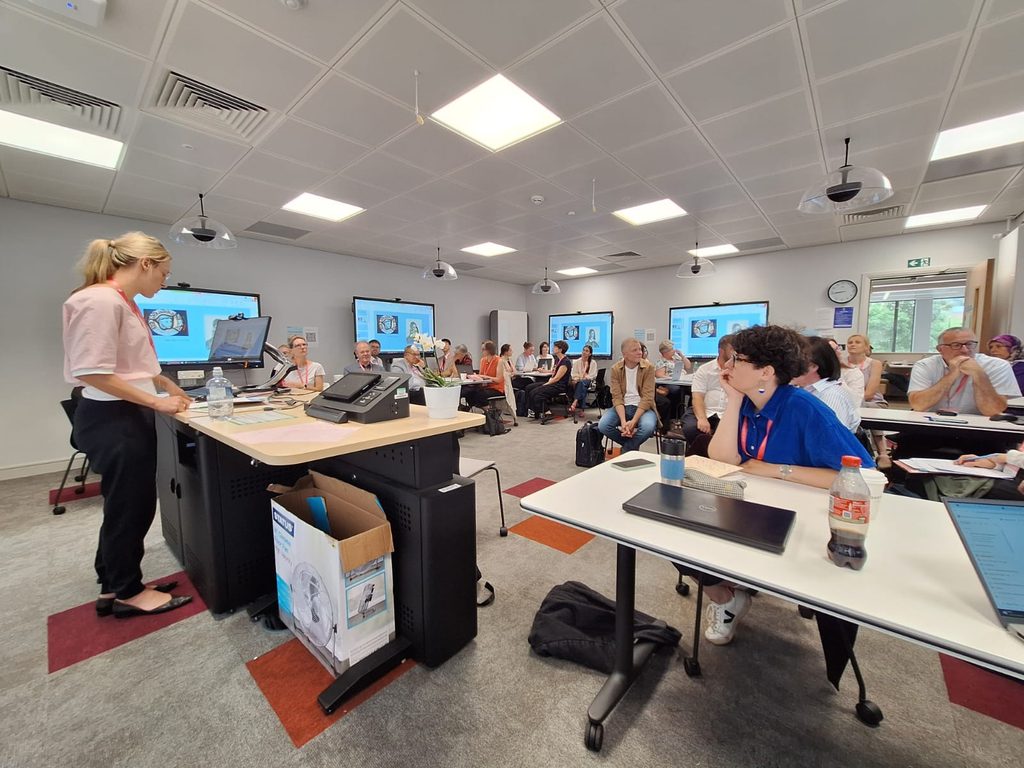
The discussion drew the three papers together around the relationship between circular and linear structures. Alphabet, refrain, rosary, and repeated reading were not ornamental features. They were techniques for directing attention, resisting the passing of time, and making an absent or historical sacred reality experientially present.
Images as Instruments for Prayer
The third session, chaired by Zuleika Murat (University of Padua), asked how images could generate devotional temporalities and mediate movement between the human and divine.
Aleksandra Krauze-Kołodziej (John Paul II Catholic University of Lublin) reconsidered medieval representations of the Last Judgement as instruments of devotion. Monumental images positioned at portals, on triumphal arches, in apses, or on western walls did more than communicate eschatological doctrine. They accompanied worshippers as they entered, moved through, and left the church, prompting repentance, self-examination, and intercessory prayer. Images of the Virgin, John the Baptist, angels, saints, donors, and the blessed also presented prayer as a reality uniting the earthly and heavenly Church. Portable ivories, diptychs, triptychs, manuscripts, rosary beads, and other small objects extended this experience beyond ecclesiastical space. Through repeated, intimate encounters, the eschatological future became a devotional reality in the present.
Sarah Borges (EHESS, Paris) and Ingrid Falque (UCLouvain) presented a close study of Utrecht University Library, MS 358, a mid-fifteenth-century Carthusian compilation produced at the Charterhouse of Nieuwlicht. The manuscript brings together excerpts on contemplation, personal comments, prayers, diagrams, decorated initials, and drawings. Its compiler did not passively copy his sources: he selected, reordered, adapted, and visually reconfigured them. Borges and Falque therefore proposed understanding the codex as a fabrique spirituelle—both a medium and a product of spiritual labour.
The manuscript’s images of angels made this process especially visible. A guardian angel shelters a praying Carthusian beneath his cloak and wings, while a diagrammatic seraph maps virtues and stages of ascent towards contemplation. These drawings draw upon monastic imagery, texts available in the Charterhouse library, local cults, and the monk’s personal devotion. Text and image function as parallel practices of compilation and meditation. The codex thus materialises a spirituality that is at once intensely personal and rooted in the communal visual, textual, and liturgical environment of the Charterhouse.
Arianna Favaretto Cortese (University of Verona) investigated moments when prayer appeared to interrupt ordinary time and bring images to life. Medieval miracle narratives describe crucifixes and Marian statues that embrace, bless, turn away from, obstruct, or even strike worshippers. These accounts find a remarkable material counterpart in surviving articulated sculptures. Movable heads, arms, and tongues allowed images to change posture, speak, or participate dynamically in devotional and dramatic contexts. Such mechanisms were not merely theatrical effects. By making the movement described in miracle stories physically perceptible, they intensified the sense that prayer could open a space of encounter between the worshipper and the divine. The image became an active participant in a sacred moment rather than a static representation.
The Future of Prayer Studies
The day concluded with the round table “The Future of Prayer Studies,” organised by Carolin Gluchowski and Youri Desplenter and moderated by Youri Desplenter. Anna Dlabačová, Marc Föcking, Mercedes Pérez Vidal (Autonomous University of Madrid), and Jonathan Reinert (Theologische Hochschule Reutlingen) opened a wide-ranging conversation that soon drew in many members of the audience.
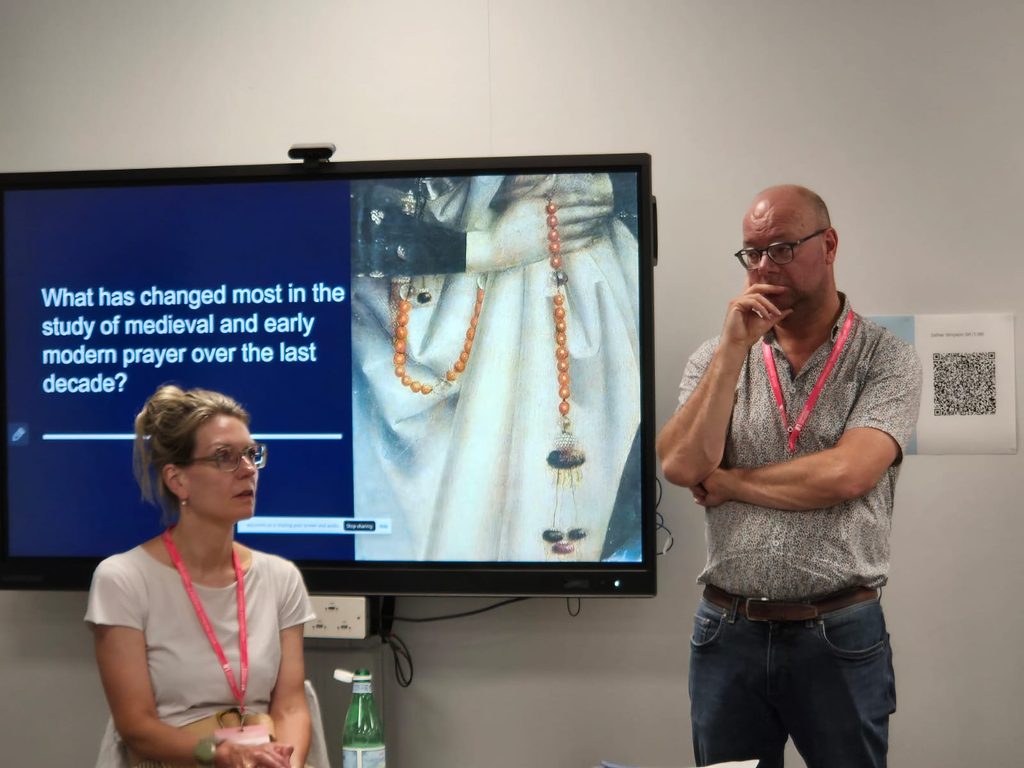
The discussion began with blind spots. Vast numbers of Latin and vernacular prayers remain unidentified, unedited, or hidden in insufficiently catalogued manuscripts and printed books. Even when material has been described, inherited umbrella terms such as “book of hours,” “prayer book,” or “devotional miscellany” can conceal the diversity of individual texts and practices. Participants stressed that the problem is methodological as well as quantitative: cataloguers do not always agree where a prayer begins and ends, how rubrics and chants should be treated, or how textual units should be compared across collections. Liturgical and musical databases may record sung items while omitting spoken prayers, making important parts of worship effectively invisible.
Other blind spots are disciplinary. Art history has often discussed “devotion” and “meditation” without analysing prayer itself, even where images carry written prayers or can be connected with particular devotional exercises. Literary history has sometimes dismissed spiritual sonnets, laude, sermons, and formulaic prayers as aesthetically secondary, while theology has tended to privilege doctrinal innovation over vernacular practice and individual compilations. Sound, silence, posture, gesture, performance, and the multidimensional materiality of prayer all require fuller integration into the field. Participants also noted institutional and national differences that can marginalise religious subjects or isolate research conducted in different languages and confessional traditions.
At the same time, the round table identified important changes. Prayer is increasingly recognised as worthy of study in its own right. Scholars are paying closer attention to individual copies, composite books, additions, images, and use-traces instead of treating manuscripts only as witnesses to an abstract original text. Research on women’s communities has been particularly productive in connecting Latin and vernacular, liturgy and devotion, books and objects, theology and daily practice. The discussion repeatedly returned to the value of approaching prayer not only as a textual genre, but as a practice that can also be observed in images, objects, narratives, communal routines, and bodily acts.
No single definition of prayer emerged—and this was itself instructive. Prayer may be communication with God, a verbal or poetic form, an embodied and spatial practice, an instrument of transformation, or a structure of attention and desire. The task for prayer studies may therefore be less to impose a closed definition than to develop shared methods and sufficiently precise working vocabularies. In this respect, the round table articulated the central purpose of PRAYTICIPATE: to connect scholarship that already exists across disciplines, languages, regions, religions, and institutions, while creating the conditions for new collaborative research.
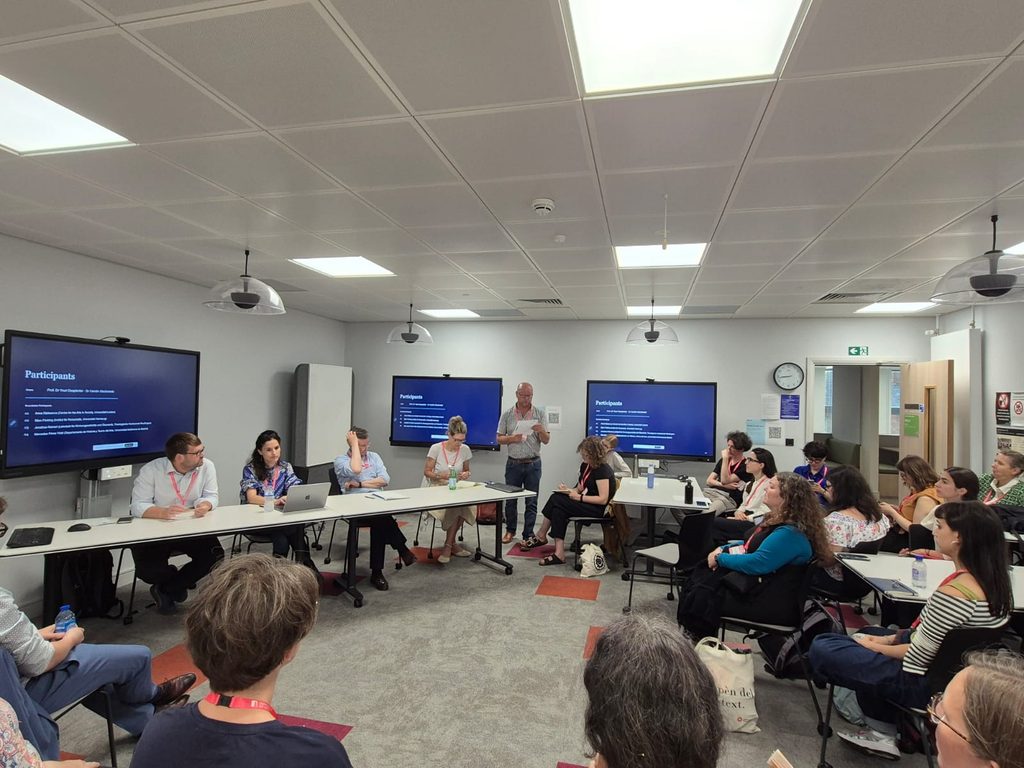
Thursday, 9 July: Religious Temporalities and Liturgical Prayer Books
The Thursday strand, organised by Youri Desplenter and Carolin Gluchowski, turned towards communal worship, theology, liturgical sound, and psalters. The sessions ranged from Poor Clare convents in East Central Europe and the “Sleepless” monks of late-antique Byzantium to tenth-century Baghdad, patristic interpretations of ceaseless prayer, Byzantine chant, digital analysis of Czech psalm manuscripts, interlinear glossing, and a cryptogram in a Romanian Psalter.
Monastic and Embodied Rhythms of Devotion
Ágnes Korondi (Hungarian National Museum Public Collection Centre / HUN-REN–NSZL Fragmenta et Codices Research Group) and Kateřina Voleková (Czech Academy of Sciences) presented the first results of a comparative project on Czech and Hungarian Marian prayers among the Poor Clares. Their case studies showed how institutional histories, observant reform, language, gender, and pastoral relationships shaped the devotional choices available to women’s communities.
At Český Krumlov, a Czech translation of the Marian Psalter was explicitly adapted to a female audience through grammatical forms and accessible vernacular language. Together with Marian versions of basic liturgical texts and related manuscripts copied by nuns, it points to a strong demand for translated material that could support private meditation, memorisation, and supplementary liturgical practice. The surviving Hungarian manuscripts associated with the Poor Clares of Old Buda reflect a different setting. Under the influence of Observant Franciscan confessors and preachers, the community favoured newer forms of Rosary devotion, including prayers on the joys and sorrows of the Virgin and vernacular instruction explaining their performance. Comparison revealed that vernacularisation was not a uniform process: local reform histories and relations between female and male communities shaped which forms of Marian prayer were translated, copied, taught, and practised.
Viktor Nedeski (Ss. Cyril and Methodius University in Skopje) examined the Akoimetoi, or “Sleepless” monks, whose organisation made ceaseless communal worship possible. Individual monks did not remain permanently awake. Instead, rotating choirs succeeded one another so that prayer continued without interruption. Their monastic rule reorganised sleep, labour, food, bodily endurance, and the canonical hours around a collective liturgical rhythm. Nedeski described this as a form of ritual technology: ordinary chronological and circadian time was not abandoned, but deliberately reordered and sanctified through disciplined repetition. The community’s continuous prayer created a temporal alternative within the monastery, anticipating the heavenly liturgy and demonstrating how bodies could bear sacred time together.
Theology, Instruction, and Interpretation
The second Thursday session, chaired by Youri Desplenter, opened with Nisa Gecekuşu Demirbaş (Fırat University), who investigated prayer and public ritual in tenth-century Baghdad under Buyid rule. In a city where Shiʿi political power coexisted with the continuing religious authority of the Sunni Abbasid caliphate, sacred spaces and practices also became media of collective identity. Mosque inscriptions, the Friday khutba, variants in the adhan, and the public commemoration of Ashura and Eid al-Ghadir gave memory and claims to authority a visible or audible presence in the city. Prayer itself was not the cause of sectarian conflict. Rather, practices of worship acquired additional political meanings when performed in a contested urban environment. Her paper made clear that prayer can unite a community while simultaneously marking boundaries between communities.
Jonathan Reinert (Theologische Hochschule Reutlingen) addressed the Christian injunction to “pray without ceasing.” Since uninterrupted verbal prayer is impossible for an individual, what could the command mean? Reinert compared four influential patristic responses and traced their later medieval resonances. Tertullian recommended fixed times connected with daily routines; Origen expanded prayer to encompass good works and the whole Christian life; Augustine understood unceasing prayer as the heart’s continuous longing for God; and John Cassian proposed the constant repetition of a short biblical verse as a means of recollection and attention. These answers generated different traditions of prayer—from canonical hours and the integration of active life into devotion to mystical desire, the Jesus Prayer, and repetitive practices associated with prayer beads. Placed alongside Nedeski’s paper, Reinert’s analysis also highlighted a fifth answer: the praying community can sustain continuity that no single body can achieve.
Maria Ivanova (Bulgarian Academy of Sciences) brought psychology and music into conversation with the history and theology of prayer. Her exploratory study considered how listening to Byzantine chant, particularly extended non-lexical vocalisation, might alter the perception of time. A pilot study with twenty participants measured prior religious, spiritual, temporal, and musical dispositions and compared them with responses after listening. The strongest association was between the immediate impact of the music and reported experiences of timelessness or transformed temporal flow; musical engagement also appeared relevant, while prior disposition alone did not explain the experience. Ivanova carefully presented these findings as exploratory rather than causal. Her contribution nevertheless opened a productive methodological path for studying sacred time not only through historical sources and theological claims, but also through the reported experience of listeners.
Prayer and Time in Psalters
The final session, chaired by Anna Dlabačová, brought together digital, codicological, linguistic, and interpretative approaches to psalters. Anna Michalcová (Czech Language Institute / Charles University) presented Handwritten Text Recognition as a tool for large-scale analysis of late medieval Czech psalm manuscripts. Her paper showed both the promise and the difficulty of moving from individual witnesses to wider networks: machine-assisted transcription can reveal patterns across a corpus, but orthographic variation, scribal practice, and the complexity of manuscript pages require careful philological training and evaluation. Digital methods can expand the scale of comparison without replacing close engagement with the manuscripts.
Youri Desplenter and Carolin Gluchowski examined the glossing of psalms in the later Middle Ages through manuscripts that place vernacular words and phrases between or alongside the Latin. Such glosses cannot be reduced to straightforward translations. The coexistence of languages on the page supported interpretation, instruction, memorisation, and devotional reading, while additions and revisions reveal changing practices over time. Interlinear psalters therefore make visible a layered process through which liturgical Latin was repeatedly made accessible, meaningful, and usable in particular communities.
Ana-Maria Gînsac (Alexandru Ioan Cuza University of Iași) closed the paper programme with a cryptogram in a mid-sixteenth-century Romanian Psalter. Her analysis demonstrated that psalters could carry more than their principal biblical text: hidden or encoded messages created additional layers of authorship, memory, identity, and interpretation. Read alongside the preceding papers, the cryptogram offered a final reminder that the page is not a transparent container. Digital recognition, glosses, scripts, and coded interventions all reveal the active work of scribes and readers in shaping the transmission and use of prayer.
Prayer as a Practice of Time
Across the six sessions, prayer emerged not as a single genre or a stable category, but as a practice that creates relations: between past, present, and future; human and divine; individual and community; word and image; body and object; ordinary routine and sacred time. The papers identified many different temporalities. Calendars and canonical hours organised recurrence; alphabets and narratives moved linearly; litanies, refrains, psalters, and rosaries created cycles; images brought the Last Judgement or the Passion into the present; articulated sculptures opened miraculous intervals; communal worship sustained continuity; poetry anticipated eternity; and chant could reshape the felt passage of time.
Three conclusions were especially important. First, media do not merely preserve prayers. Their formats and affordances actively shape what prayer can become. Second, the distinction between private and communal prayer is porous: even the most personal book, poem, image, or practice is formed by liturgical traditions, institutional structures, communities, and networks of transmission. Third, the future of prayer studies depends on collaboration. No single discipline can adequately account for texts, images, sounds, bodies, spaces, objects, languages, and experiences at once.
The Leeds programme demonstrated the value of PRAYTICIPATE as a meeting place for precisely this work. By connecting detailed case studies with shared methodological questions, it helped make prayer visible as one of the most versatile and consequential practices of medieval and early modern life. The sessions did not resolve the temporal paradoxes of prayer—and did not seek to. Instead, they showed how fruitful those paradoxes can be: prayer belongs to time, yet reaches towards eternity; it repeats inherited forms, yet changes with every performance; it may be solitary, yet is never entirely individual; and it can order everyday life while opening a space beyond the ordinary.
We are grateful to the COST Association for supporting the programme and to all organisers, chairs, speakers, round-table participants, and audience members for their generous contributions. Their discussions made the IMC 2026 programme not simply a sequence of papers, but a collective exploration of what it means to study participation through prayer.